An LLM-generated table can look trustworthy. Every row may have a citation. But a citation is not the same thing as provenance.
A model can recall a row from parametric memory, then attach a plausible page-level citation after the fact. The table appears grounded, but the cited page may not actually support the row. For structured outputs, that distinction is critical. A single unsupported row or even a cell value can distort downstream analysis, benchmark construction, knowledge base updates, or an enterprise dashboard.
In our paper, Stage-Audit: Auditable Source-Frontier Discovery for Cross-Wiki Tables, we study this problem in the context of cross-Wikipedia table construction.
To examine this issue, we introduce a task called Seed2Frontier discovery: starting from a seed Wikipedia page, the system must find the complementary pages needed to assemble a structured table for an input natural language query. We call the set of pages the table draws on beyond the seed its source frontier. For example, consider the query, “Which films won Best Picture in the 2020s, who directed each film, and how much did each film gross?” The Best Picture seed page identifies the winning films but does not provide all their directors and grosses. Those details appear on the individual film pages, so the frontier includes those pages. The system must find them and assemble the answer across them. No single page contains the full table.
This is exactly the kind of task where LLM agents seem useful: multi-hop, open-ended, and structured. It is also exactly where weak provenance can hide.
A Table Can Be Plausible and Still Be Wrong
Source-grounded generation is often evaluated after the output is produced. Did the answer include citations? Do the claims appear supported? Can a judge verify the final response?
Stage-Audit changes that control in two ways: when it happens and how fine-grained it is.
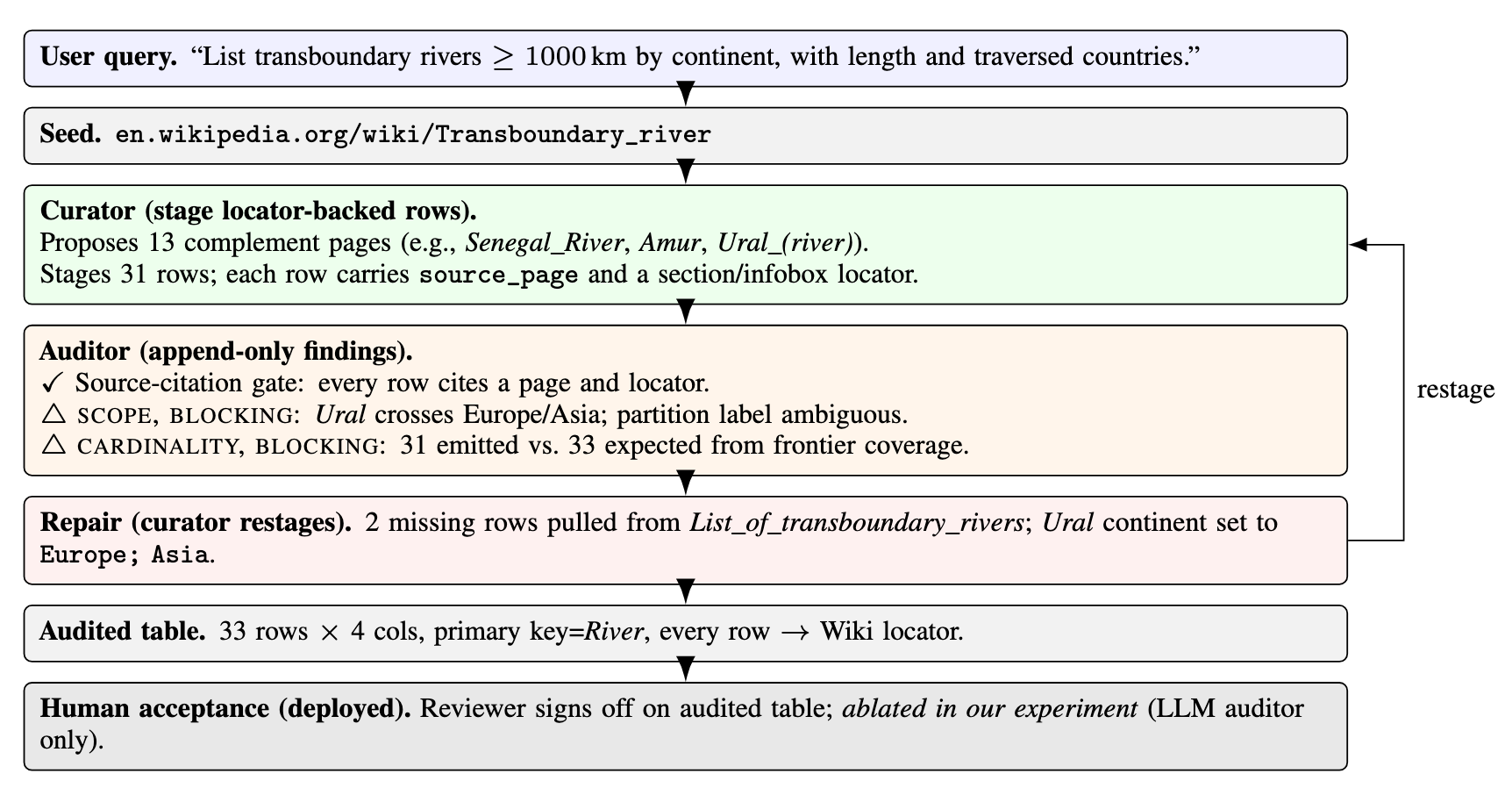
First, the check moves earlier in the pipeline. Instead of judging only the finished answer, the system gates rows as they are staged. Before a row enters the table, it must carry a source URL and an evidence locator pointing to the section, table, or infobox that supports it. If the model remembers a fact, that memory may help it decide where to look, but it cannot justify the row.
Second, the unit of evidence gets smaller. A citation attached to the finished answer does not establish which passage supports which row. Stage-Audit links each row to a specific locator, making its support independently auditable.
This matters because a table makes a promise about what it contains. We call that promise, a table contract. For the Best Picture query, the contract calls for one row for each winning film in scope, with director and gross columns and a clear rule for which films belong. Every row could be factually supported and the table could still fail as an answer: it might omit a winner, include a nominee, use an ambiguous key, or group the rows incorrectly. Row-level evidence lets the auditor check individual facts. Separate table-level checks cover keys, grouping, cardinality, and completeness.
A Governance Layer, Not a New Retrieval Trick
Stage-Audit is not proposed as a new retrieval method. It is a governance protocol that can sit on top of an LLM or agentic framework used for table curation.
The protocol separates responsibilities.
A curator proposes source pages and stages rows (with evidence locators). An auditor cannot edit the canonical table. Instead, the auditor appends findings under a 12-check taxonomy covering factual, structural, and scope-related issues.
The taxonomy covers factual failures such as unsupported rows, structural failures such as invalid keys or schema mismatches, and scope failures such as missing partitions, wrong cardinality, or incomplete source-role coverage.
This separation matters. If the same agent both generates and silently repairs the table, audit evidence can blur into self-correction. Stage-Audit keeps the staged artifact and audit findings distinct, so errors remain visible and repair decisions can be governed.
In deployment, the protocol also includes a human acceptance step. The paper’s main experiment ablates that step, along with repair-restage iteration, to isolate the value of the curator-auditor policy itself.
Below is an example of Stage-Audit walkthrough on a curated Seed2Frontier instance.
Measuring the Source Frontier
The paper introduces a 51-instance Seed2Frontier evaluation set spanning 15 top-level domains, including geography, culture, science, politics, sports, business, technology, religion, food, education, environment, health, history, law, and society.
Each instance pairs a natural-language table query with a Wikipedia seed page. For 45 instances, the set includes labeled complement pages. It also includes primary-key ground-truth tables.
The evaluation compares four configurations:
- memory-only generation, which uses parametric memory without producing a source frontier
- seed-outlink enumeration, which deterministically collects all outlinks from the seed page
- a vanilla LLM curator, which asks the model for complement pages and rows without the proposed source gate or audit step
- Stage-Audit-governed curation, which adds source-citation requirements and auditor findings
The primary evaluation axis is source-frontier quality: whether the system finds the right complement pages while avoiding unsupported or irrelevant pages.
What the Audit Changes
The absolute scores show how difficult the task remains. On the 45 instances with labeled complement pages, Stage-Audit reaches a source-frontier F1 of 0.451, compared with 0.334 for the vanilla LLM curator. An F1 of 0.451 also makes clear that the task is far from solved.
The baselines reveal the underlying trade-off. Enumerating every outlink from the seed produces 612.3 pages per instance on average, with 0.580 recall but only 0.020 precision. Stage-Audit produces a much smaller frontier, averaging 11.4 pages, with 0.505 precision, compared with 0.356 for the vanilla LLM curator. These results amount to a 35% relative F1 gain and a 42% relative precision gain. The comparison adds a source gate and an audit policy without introducing a new retrieval method.
Across the 51 instances, the auditor produced 182 findings classified by issue type and severity. Importantly, the audit taxonomy catches issues that a row-level citation gate alone would miss, such as scope, partition, and cardinality failures.
A cross-model appendix repeats the comparison on Llama 3.3 70B. The gain is smaller but directionally consistent across frontier recall, precision, and F1. The paper interprets the policy contribution as most pronounced on stronger instruction-following models, where the curator can produce cleaner citation-tagged rows for the auditor to filter.
Why This Matters for Agentic Data Systems
Agentic AI systems increasingly produce structured artifacts: tables, benchmark sets, evaluation datasets, knowledge base entries, reports, and operational records.
These artifacts need a different kind of grounding than free-text answers. It is not enough to say the output cites sources. The system must show which source supports which row, how each source entered the frontier, whether the schema is coherent, and whether the table’s scope claim is defensible.
That is the broader contribution of Stage-Audit. It treats source grounding as an artifact lifecycle: proposed, staged, audited, repaired, and accepted.
For enterprise AI and data management research, this framing is useful. It gives teams a way to reason about structured LLM outputs as governed data products rather than one-off generations.
The Practical Takeaway
Stage-Audit does not claim that a source locator certifies truth. A locator-backed row can still be wrong if the extractor misreads the cited content, if the locator drifts, or if the source itself is incomplete.
But the protocol improves the failure mode.
Instead of allowing an unsupported row to hide behind a plausible citation, Stage-Audit requires each accepted row to have an explicit witness. Instead of a table silently mixing memory and evidence, the artifact records source roles and audit findings. Instead of treating citations as decoration, the system makes provenance part of the table contract.
For teams building compound AI systems, that distinction is critical.
The next generation of source-grounded AI will need more than retrieval and citations. It will need auditable evidence trails that match the structure of the artifacts being produced.
Read the paper: Stage-Audit: Auditable Source-Frontier Discovery for Cross-Wiki Tables
Written by Chen Shen and Megagon Labs